
Psychologist vs Counsellor in Australia: What’s the Difference?
People usually ask me this after they've already been quoted a price.
Or they ask whether they need to see a GP first and get a Mental Health Treatment Plan before booking with me.
Or simply:
"Can I claim a Medicare rebate?"
These are all reasonable questions. The Australian mental health system can be surprisingly confusing, so I thought I'd explain the difference between a psychologist and a counsellor, and how Medicare fits into it.
What's the difference between a psychologist and a counsellor?
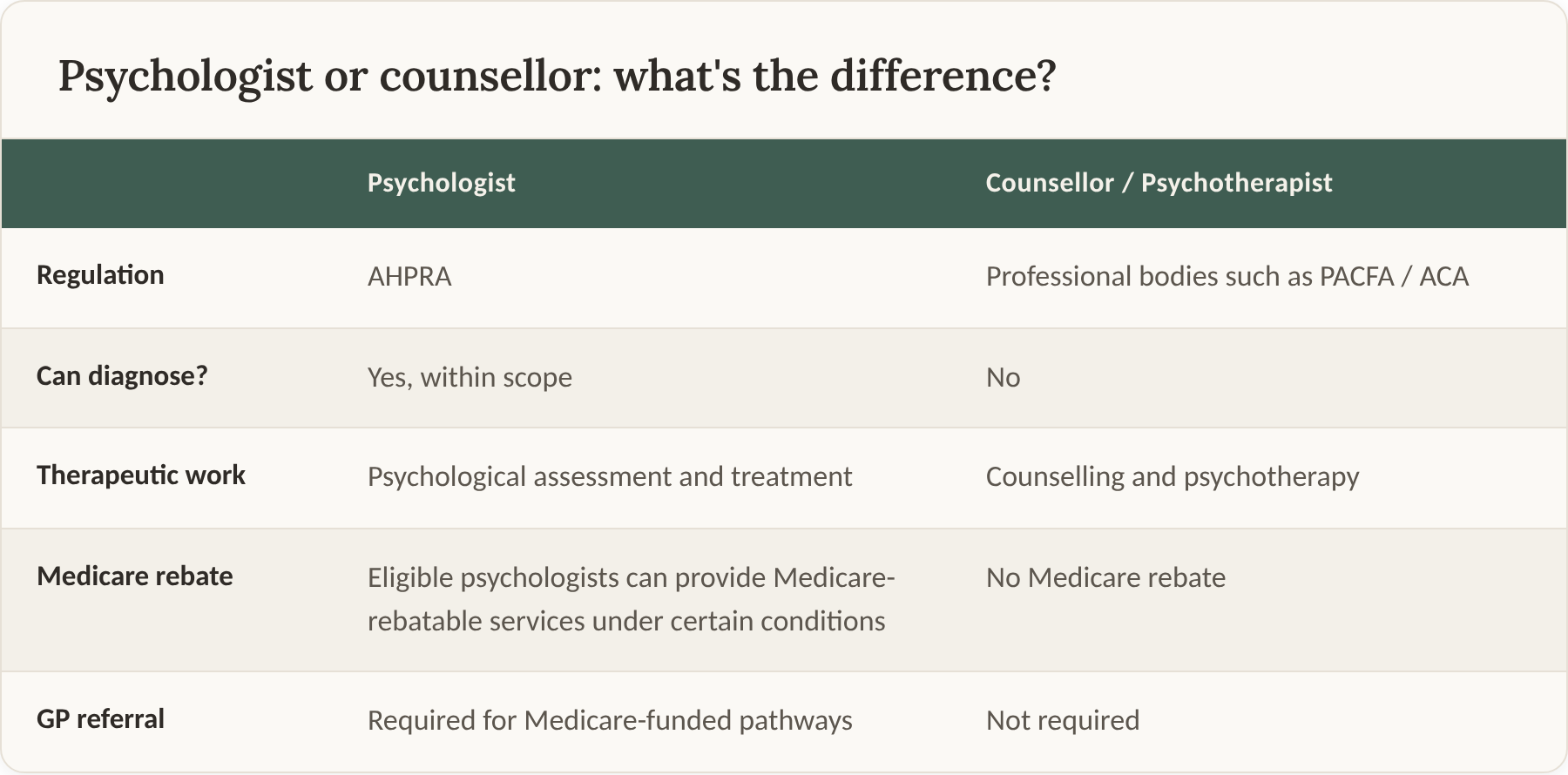
Psychologists and counsellors are different professions, with different training pathways, regulatory frameworks and scopes of practice.
Psychologists are registered health professionals regulated through AHPRA. Depending on their qualifications and scope, they can provide psychological assessment, diagnosis and psychological treatment.
Counsellors and psychotherapists are not registered through AHPRA. Many are registered with professional bodies such as PACFA or ACA, which set professional and ethical standards for their members.
There is some overlap. Both may work with concerns such as burnout, anxiety, stress, grief, relationships and major life changes.
The difference is not simply about what happens in the therapy room. It is also about how each profession is regulated and how Medicare applies to their services.
Does Medicare cover counselling in Australia?
No. Counselling and psychotherapy with a counsellor are not eligible for a Medicare rebate.
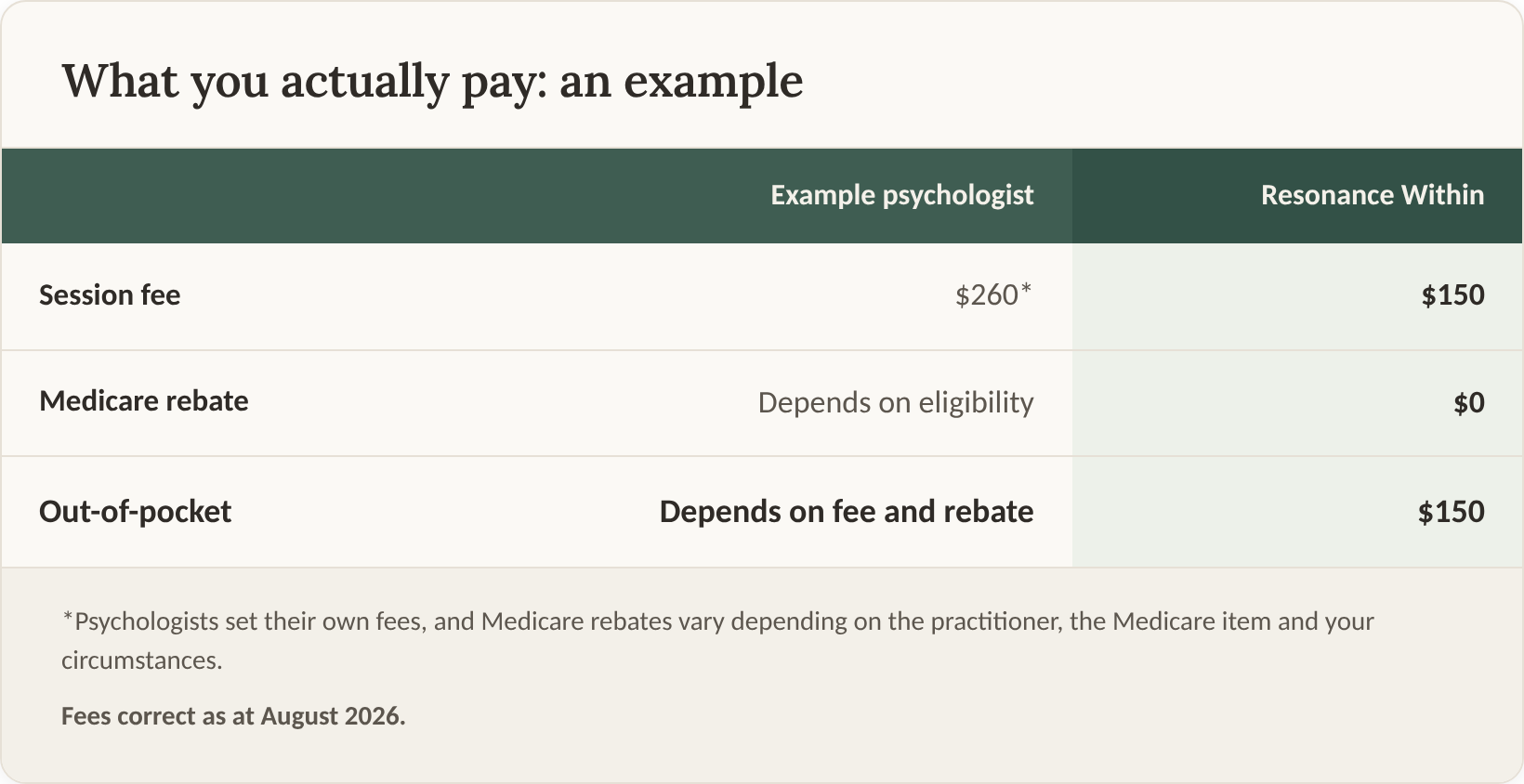
My fee at Resonance Within is $150 for a 50-minute session, with no Medicare rebate.
This can initially make counselling look more expensive than psychology. But it is worth looking at the actual out-of-pocket cost, rather than simply whether a rebate is available. Psychologists set their own fees, and the Medicare rebate varies depending on the practitioner, Medicare item and your circumstances.
So the more useful question isn't always:
"Does this practitioner offer a rebate?"
It may be:
"What will I actually pay, and what kind of support am I looking for?"
Do I need a GP referral or Mental Health Treatment Plan?
No. You can see a private counsellor without a GP referral, Mental Health Treatment Plan or diagnosis. You can contact a counsellor directly and make an appointment.
This is one of the things people sometimes find freeing about counselling. You don't have to wait until your difficulties become a diagnosable mental health condition before seeking support.
You might be going through a major life transition. You might be feeling overwhelmed.
Perhaps something from your past keeps shaping how you relate to yourself and to other people.
Or perhaps you're functioning well on the outside, and finding it increasingly difficult on the inside.
You don't need a diagnosis to talk about these things.
Private counselling also isn't subject to Medicare session limits. How many sessions, and how often, is something you and your counsellor decide together.
When might a psychologist be the better choice?
There are situations where seeing a psychologist, psychiatrist or another mental health professional is the more appropriate pathway. For example, if you need:
Formal psychological assessment, such as an ADHD or autism assessment
Diagnosis
Support for a serious or complex mental health condition
Psychiatric assessment or medication management
Access to Medicare-funded psychological treatment
Sometimes you may also work with a psychologist and a counsellor at different points in your life. It's about finding the right kind of support for what you need.
When might counselling be a good fit?
Counselling can be particularly helpful when you want a space to explore what is happening in your life without necessarily needing a formal diagnosis or psychological assessment.
For example:
anxiety, stress or emotional overwhelm
relationships and boundaries
family-of-origin difficulties
self-esteem and identity
recurring patterns you can see clearly but can't seem to shift
Sometimes the question isn't:
"What's wrong with me?"
It might be:
"Why do I keep responding this way, even when I know I want something different?"
Or simply:
"Something doesn't feel right, and I want to understand what's happening."
That's a perfectly valid reason to seek counselling. And you don't have to know the answer before making an appointment. Sometimes the first step is just a conversation, and seeing whether it feels like the right fit.
Frequently asked questions
Can I see a counsellor without a Mental Health Treatment Plan?
Yes. You can book a private counselling session directly. No GP referral or diagnosis is required.
Can I claim Medicare for counselling?
No. Counselling and psychotherapy provided by counsellors are not eligible for a Medicare rebate.
Can I claim private health insurance?
Not currently
Is a counsellor the same as a psychologist?
No. They are different professions with different training and regulatory frameworks. There can be overlap in therapeutic work, but psychologists can provide psychological assessment and diagnosis within their scope, while counsellors work within the scope of counselling and psychotherapy.
How many counselling sessions do I need?
There is no fixed number. Some people benefit from a few sessions focused on a particular issue, while others choose longer-term psychotherapy. This can be discussed together based on your needs.
A note for GPs and allied health professionals
I'm a PACFA-registered counsellor and psychotherapist and work within the scope of counselling and psychotherapy. I don't diagnose, and I'm not a substitute for psychiatric care, psychological assessment or other specialist mental health services when these are needed.
I may be particularly useful for people who:
don't need a formal assessment or diagnosis
have used their Medicare-rebatable sessions but still want therapeutic support
are experiencing burnout, life transitions, anxiety, relationship difficulties or life transitions
are waiting for a psychologist and would benefit from support in the meantime
would feel more comfortable working in Mandarin (普通话) or Cantonese (粤语), with implicit understanding of Chinese culture.
No referral is required. With the client's consent, I'm also happy to communicate with their GP or other treating professionals where appropriate.
If you're in crisis or don't feel able to keep yourself safe, please contact Lifeline on 13 11 14, or 000 in an emergency. Counselling is not a substitute for crisis care.

About the Author: Christine Yau, PhD
Hi there! I'm Christine, I'm a PACFA-registered counsellor and psychotherapist in private practice in Sydney, working in English, Cantonese (粤语) and Mandarin (普通话). I see people in Drummoyne and Surry Hills, and online across Australia. Before this I spent years in corporate training and school leadership, which is where I first started noticing how many capable people are quietly running on empty.